Rodent control in Gwinnett County requires structural defense tailored to local construction practices rather than open-ended poison baiting. A house mouse requires an opening of only 0.25 inches to enter a foundation,…
Rodent control in Gwinnett County requires structural defense tailored to local construction practices rather than open-ended poison baiting. A house mouse requires an opening of only 0.25 inches to enter a foundation, while an adult roof rat can slip through gaps measuring 0.5 inches along roof returns, soffits, and crawlspace vents. Older ranch homes in Pew Creek and Woodhaven frequently develop settled foundation sill cracks, whereas two-story builds in Bramlett Forest and Abington Green commonly expose gaps where architectural rooflines meet attic fascia boards. Because rodents chew electrical wiring coatings and tear through fiberglass batting to create nesting runs, addressing them requires immediate mechanical trapping paired with permanent architectural sealing. If an attic contains isolated scratching noises along drywall ceilings, focused trapping and exterior point-sealing restore security; if extensive urine trails and contaminated insulation span 1,500 square feet, the remediation requires comprehensive insulation extraction and sanitation alongside physical entry denial.
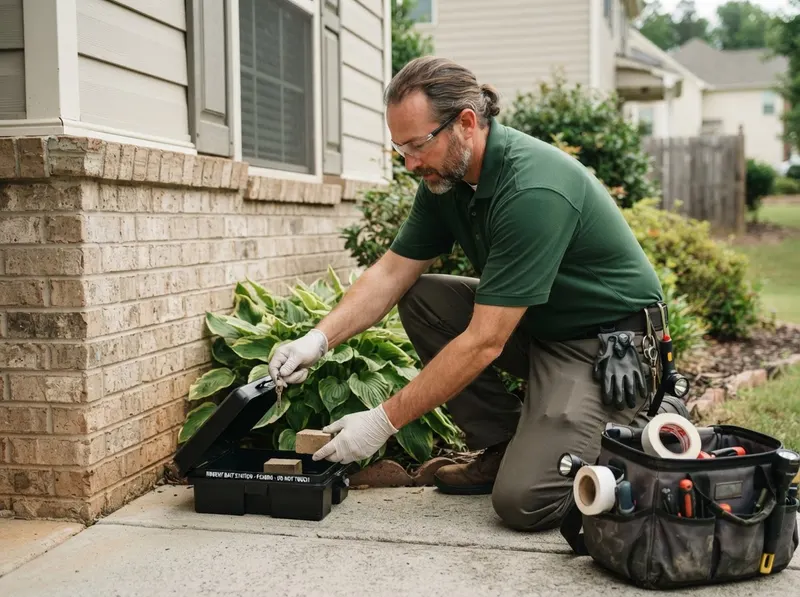
Effective rodent control operates through four distinct phases: 1. A physical perimeter assessment maps out exterior food sources, foundation penetrations, AC line set entries, and uncapped weep holes. 2. Technicians install covered mechanical catch stations inside ceiling voids and basements, avoiding open rodenticide pellets that risk pet exposure or cause dead rodents to decompose behind drywall. 3. Physical exclusion repairs seal identified entryways using 19-gauge galvanized steel hardware cloth and metal-infused sealants that rodent teeth cannot penetrate. 4. Follow-up visits monitor trap catches over 7 to 14 days until zero activity registers, concluding with the sanitization of attic pathways.
Properties bordering mature hardwood canopies near Rhodes Jordan Park, Freeman's Mill Park, or the Pew Creek basin experience elevated roof rat pressure during cold snaps in November through February. Homes in Castlegate, Huntington, Chandler Woods, and River Oak Village face continuous risks when tree branches grow within 6 feet of gutters, providing aerial pathways directly onto shingles. Selecting a targeted mechanical exclusion program ensures long-term home defense without forcing property owners into rigid, multi-year recurring chemical subscriptions.
Every job gets a firm, written price after a free on-site visit.
Tell us about your mouse and rat control job in Lawrenceville and we'll send a clear, written quote, usually the same day.
 Peachwood Pest Control